Moissanite vs Lab-Grown Diamond: Read This FirstMoissanita vs. diamante de laboratorio: lee esto primero
By Ryland, founder of Airwaves · Updated June 2026Por Ryland, fundador de Airwaves · Actualizada en junio de 2026
Esta guía está en inglés por ahora. Pronto la tendremos en español.
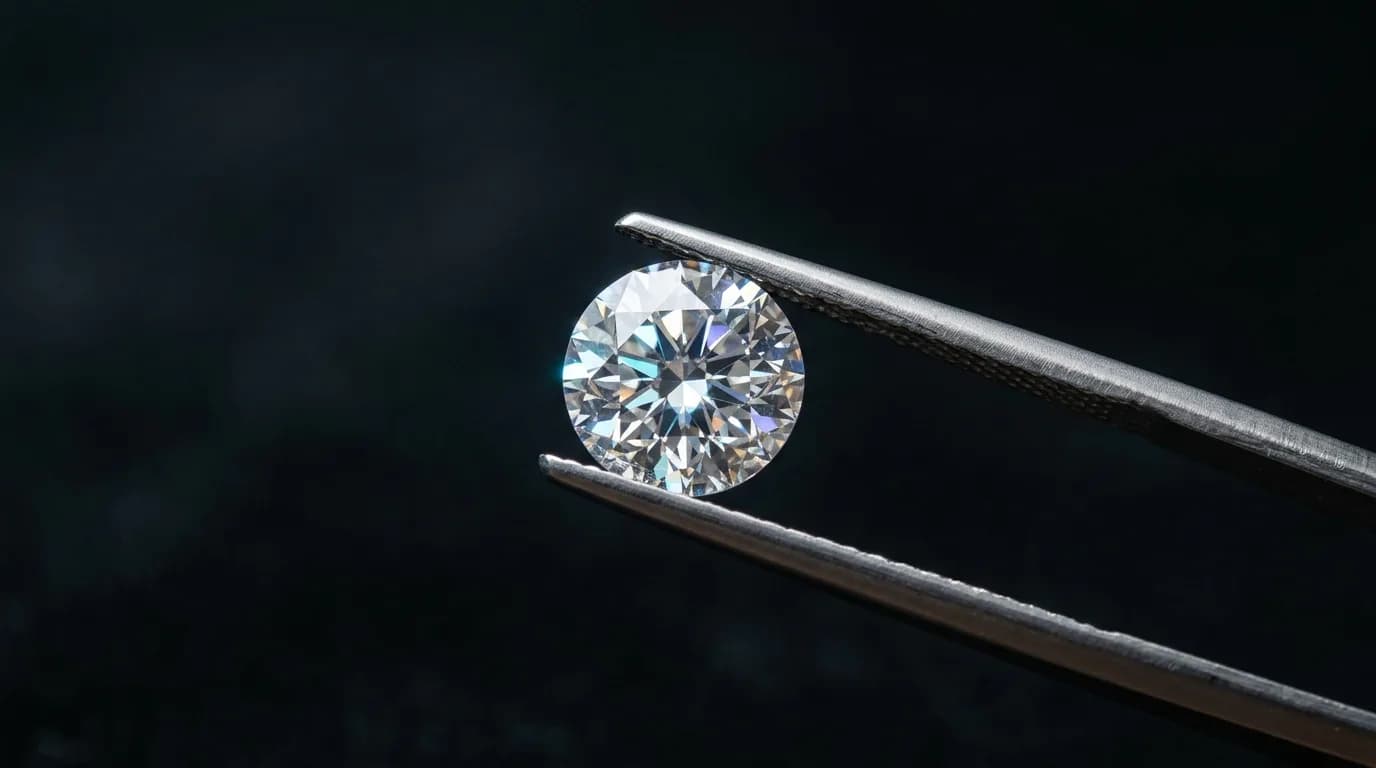
Here's a question that trips up a lot of shoppers: if moissanite and lab-grown diamonds are both made in a lab, why does one cost five times more than the other? It's a fair question, and the answer is more interesting than "one's better." They're different stones with different strengths — and the right pick depends entirely on what you actually care about.
They're not the same stone
A lab-grown diamond is chemically identical to a mined diamond — same carbon, same crystal structure, just grown in a reactor over a few weeks instead of a billion years underground. Moissanite is a different material entirely: silicon carbide. It looks diamond-like to the eye, but it's its own gem with its own properties.
So this isn't "real vs fake." Both are real, lab-created gemstones. The differences are physical, and they're easy to understand.
Sparkle: moissanite throws more fire
Moissanite's dispersion (0.104) is more than double a diamond's (0.044), lab-grown or not. That means more of those rainbow flashes, especially in bright light. Lab diamonds give you the classic, restrained diamond sparkle; moissanite gives you something flashier. Neither is "better" — it's a taste call, and now you know which is which.
Hardness: a near-tie
Lab diamond is a perfect 10 on the Mohs scale. Moissanite is 9.25 — a hair softer, but still harder than sapphire and far beyond anything that scratches in daily life. For an everyday ring, both will outlast you. This is not the deciding factor for most people.
Price: the part that actually decides it
This is where the two part ways. Lab-grown diamonds are far cheaper than mined diamonds — but a one-carat lab diamond still runs several hundred to a couple thousand dollars once it's set. A comparable one-carat moissanite is typically a few hundred, all in.
If you put the same budget into each, moissanite buys you a dramatically bigger, sparklier stone. Put the other way: moissanite gets you the look of a far more expensive ring for a fraction of the spend.
The value gap in real numbers
Say you have $1,500 to spend. In a lab-grown diamond, that might get you a modest center stone once it's set in a band. In D-color moissanite on S925 silver, the same $1,500 — often far less — buys a noticeably larger, brighter centerpiece with money left over. That's the whole trade: with a lab diamond you're paying extra for the word "diamond," not for anything you can see across a room.
It's worth being clear-eyed about why lab diamonds cost more. They're grown in expensive reactors under high pressure and heat over weeks, then cut and graded through the diamond pipeline. Moissanite's process is cheaper and its supply chain shorter — so the savings are structural, not a quality shortcut.
Do either hold their value?
Neither is an investment, and it's worth saying plainly. Lab-grown diamonds have actually dropped in price fast as production scaled, so a lab diamond bought today may be worth noticeably less in a few years. Moissanite doesn't appreciate either. If resale is your goal, neither stone is the answer — but if you're buying a ring to wear and love, that frees you to simply pick the one that looks best for your budget. That's usually moissanite.
So who should pick which?
Choose a lab-grown diamond if having an actual diamond — the exact same material as a mined one — matters to you emotionally. Choose moissanite if you want the most sparkle and the most ring for your money, and you're happy with a stone that looks the part to everyone who isn't holding a loupe.
We're a moissanite house, so we're biased — but honestly, for most shoppers chasing value and shine, moissanite wins on the numbers.
QuestionsPreguntas
Is moissanite cheaper than a lab-grown diamond?
Yes, significantly — usually a fraction of the price for the same size and color. The gap comes from the material and the supply chain, not from quality.
Can you tell moissanite from a lab diamond?
Only by the fire. Moissanite sparkles with more rainbow flash; lab diamonds are more restrained. To the everyday eye on a hand, both read as a brilliant white stone.
Do lab diamonds and moissanite both pass a diamond tester?
Lab diamonds pass as diamond. Moissanite passes a basic thermal tester but is correctly identified by a dual moissanite/diamond tester.
Is a lab-grown diamond more durable than moissanite?
Marginally on paper — 10 vs 9.25 on the Mohs scale — but both are far harder than anything they'll meet in daily wear. Neither will scratch or cloud, so durability isn't a real deciding factor between them.
Which is better value, moissanite or lab diamond?
Moissanite, clearly, if value is the goal — the same budget buys a larger, sparklier stone, and lab diamond prices have been falling as supply grows. Lab diamond only wins if owning an actual diamond specifically matters to you.
Keep readingSigue leyendo
- Moissanite vs Diamond: An Honest ComparisonMoissanita vs. diamante: una comparación honesta →
- Is Moissanite Worth It? An Honest Take¿Vale la pena la moissanita? Una opinión honesta →
- The No-Nonsense Engagement Ring Buying GuideLa guía sin rodeos para comprar un anillo de compromiso →
- How Much Does Moissanite Cost? A Clear Price Breakdown¿Cuánto cuesta la moissanita? El precio explicado →