Moissanite vs Diamond: An Honest ComparisonMoissanita vs. diamante: una comparación honesta
By Ryland, founder of Airwaves · Updated June 2026Por Ryland, fundador de Airwaves · Actualizada en junio de 2026
Esta guía está en inglés por ahora. Pronto la tendremos en español.
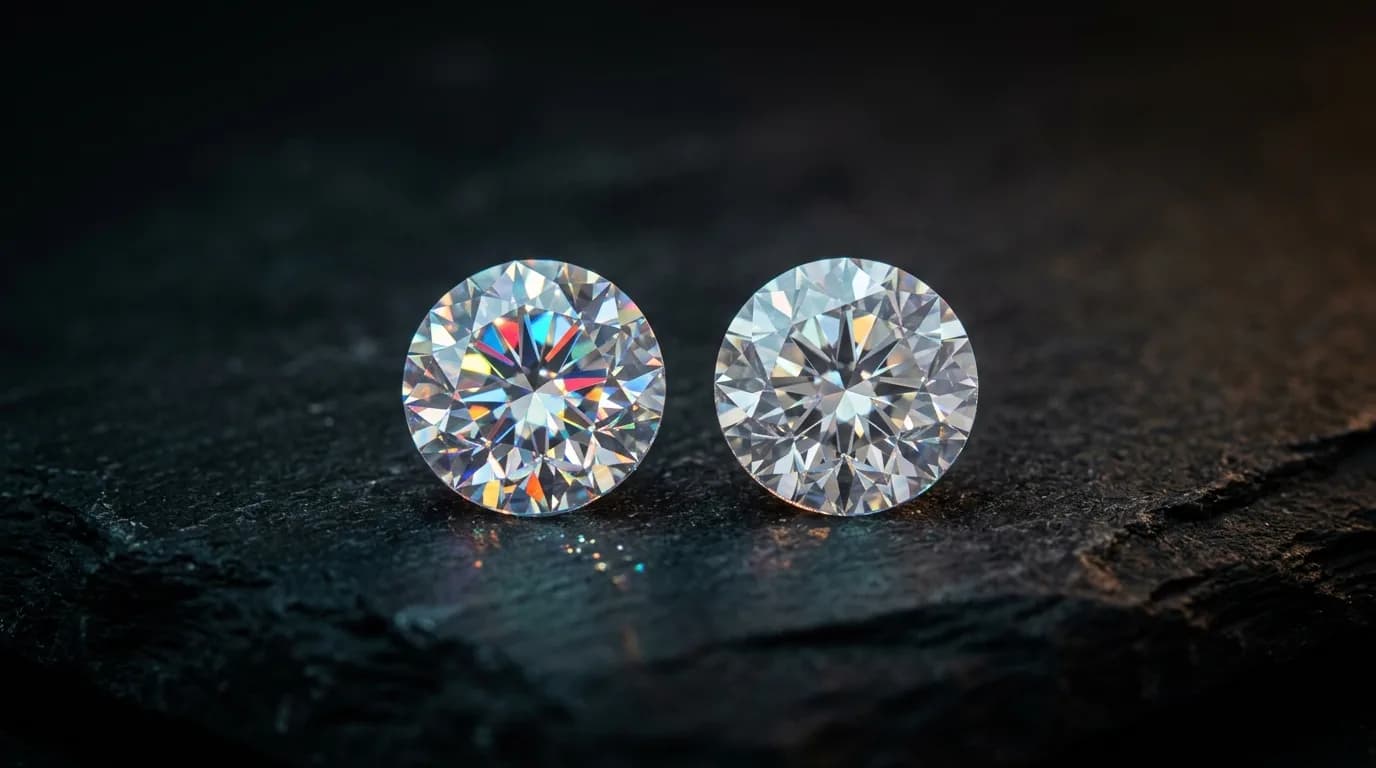
Across a dinner table, almost nobody can tell them apart — including, on a bad day, the jeweler. Put a D-color moissanite next to a diamond on someone's hand and most people guess wrong. The differences are real, but they come down to three things: fire, hardness, and price. Here's the honest breakdown, including the part most jewelry stores would rather skip.
What moissanite actually is
Moissanite is silicon carbide — a real, distinct gemstone, not glass and not cubic zirconia. A French chemist named Henri Moissan found it in an Arizona meteor crater in 1893 and briefly thought he'd struck diamonds. Natural moissanite is almost nonexistent, so every stone in jewelry today is grown in a lab to gem quality.
That lab origin is the whole reason it costs a fraction of a diamond: no mine, no diamond supply chain, no eighty years of "a diamond is forever" baked into the price.
Fire: moissanite wins, and it's not close
"Fire" is the colored light a stone throws — those rainbow flashes when it catches the light. It's measured by dispersion, and moissanite's is 0.104 versus a diamond's 0.044. Its refractive index is higher too: 2.65 against 2.42.
In plain terms, moissanite throws more than twice the fire of a diamond. In bright light it can sparkle almost disco-bright. Most people love it. If you specifically want the subtler, icy-white sparkle a diamond is known for, that's the one place the two genuinely diverge — and it's worth knowing before you buy, not after.
Hardness: both built for a lifetime
On the Mohs scale, diamond is a 10 — the hardest natural material there is. Moissanite is 9.25, second only to diamond among stones you'll actually find in jewelry, and a notch above sapphire. For an everyday ring, that means it won't scratch, chip, or cloud with normal wear. It's a forever stone, not a five-year placeholder.
Price: this is the headline
A moissanite of the same size, color, and clarity as a diamond costs a fraction of the price — often a tenth or less. A one-carat diamond runs anywhere from $3,000 to $20,000 depending on its grades. A comparable one-carat moissanite is typically a few hundred dollars.
That gap isn't a quality compromise. It's the absence of mining and markup. You're paying for the stone, not the story.
Color and clarity: what to look for
Diamonds are graded on color (D–Z) and clarity (Flawless to Included). Moissanite is graded the same way, and the grade matters just as much. Every Airwaves stone is D-color — the top, completely colorless grade — and eye-clean. Each one is GRA certified, and the certificate ships in the box, so you're never taking the grade on faith.
The quick spec comparison
If you want it at a glance:
| Moissanite | Diamond | |
|---|---|---|
| Hardness (Mohs) | 9.25 — harder than sapphire | 10 |
| Fire (dispersion) | 0.104 — more than double | 0.044 |
| Brilliance (refractive index) | 2.65 | 2.42 |
| Price per carat | A few hundred dollars | $3,000–$20,000+ |
| Origin | Always lab-grown | Mined or lab-grown |
| Everyday durability | Excellent | Excellent |
Read that table and the pattern is clear: moissanite matches or beats a diamond on every practical measure except one — a diamond's specific, subtler sparkle and its status. Everything else favors moissanite, and the price isn't close.
How to tell a moissanite from a diamond
There are only a few reliable tells. The first is fire: in bright light, moissanite throws noticeably more rainbow flash. The second is "doubling" — under magnification, a moissanite's facet edges can appear slightly doubled, which a diamond's never do. The third is a tester: moissanite passes a basic thermal diamond tester (it conducts heat like a diamond), but a dual moissanite/diamond tester reads electrical conductivity and correctly identifies it.
For everyone who isn't a jeweler holding a loupe, though, the honest answer is: you can't tell on a hand. That's precisely why moissanite works so well as a diamond alternative.
Does moissanite hold its value?
Here's the honest part most sellers skip. Moissanite is not an investment — it doesn't appreciate, and you won't resell it for a premium. But neither will your diamond: mined diamonds famously lose most of their retail value the moment you leave the store, often reselling for a fraction of what you paid. So "resale value" is a weak argument for either. If you're buying a ring to wear and love, not to flip, this is a non-issue for both stones — and moissanite means you weren't overpaying to begin with.
The ethics: no mine, no markup
Because moissanite is grown in a lab, it sidesteps the biggest concerns with mined diamonds entirely — no mining, no conflict-stone risk, and a far smaller environmental footprint. For a lot of buyers that's reason enough on its own, and it happens to come at a fraction of the price. If a mining-free, conflict-free stone matters to you, moissanite is one of the clearest choices in jewelry.
Why we set ours in S925 silver
Most stores set moissanite in gold or platinum, which quietly hands the price advantage right back — you save on the stone and pay it all back in the band. We set ours in solid S925 sterling silver: hypoallergenic for most people, far kinder on the total price, with 18K gold and rose-gold plating available if you want the gold look. The result reads identically to a diamond piece across a room, for a small fraction of the all-in cost.
So which should you choose?
If you want maximum sparkle and value, and you're happy with a lab-grown stone, moissanite is genuinely hard to beat. If the specific status of a mined diamond matters to you, that's a fair and personal call — but optically, on a hand, in real life, almost no one will know the difference.
Our honest recommendation: unless owning a mined diamond specifically is the point for you, moissanite gives you the look, the durability, and more fire, while freeing up the thousands you'd have spent on the diamond markup for the wedding, the honeymoon, or literally anything else.
QuestionsPreguntas
Can people tell moissanite from a diamond?
Rarely at a glance. The one giveaway is fire — moissanite flashes more rainbow light, especially in bright sun. Side by side a trained eye might catch it; across a table, almost no one can.
Does moissanite pass a diamond tester?
Yes. It passes a standard thermal tester because it conducts heat like diamond. Only a dual moissanite/diamond tester, which also reads electrical conductivity, will correctly flag it as moissanite.
Will moissanite cloud or lose sparkle over time?
No. At 9.25 Mohs it resists scratching and won't yellow or cloud. A wipe with warm water and mild soap keeps it bright for life.
Is moissanite a good choice for an engagement ring?
Yes — it looks like a diamond, throws more fire, is hard enough for daily wear (9.25 Mohs), and costs a fraction, so you can put the savings toward the life together. It's one of the most popular diamond alternatives for exactly these reasons.
How much cheaper is moissanite than a diamond?
Typically around a tenth of the price or less for the same size and color. A one-carat diamond runs $3,000–$20,000+; a comparable one-carat moissanite is usually a few hundred dollars.
Is moissanite a real gemstone or a fake diamond?
It's a real, distinct gemstone — silicon carbide — not a fake or an imitation. It isn't a diamond and doesn't pretend to be; it's its own stone that happens to look diamond-like and outperform it on fire and price.
Keep readingSigue leyendo
- Moissanite vs Cubic Zirconia: Why It's Not a Fair FightMoissanita vs. circonia cúbica: no es una pelea justa →
- Moissanite vs White Sapphire: Which Diamond Alternative Wins?Moissanita vs. zafiro blanco: ¿cuál alternativa al diamante gana? →
- Is Moissanite Worth It? An Honest Take¿Vale la pena la moissanita? Una opinión honesta →
- The No-Nonsense Engagement Ring Buying GuideLa guía sin rodeos para comprar un anillo de compromiso →