The No-Nonsense Engagement Ring Buying GuideLa guía sin rodeos para comprar un anillo de compromiso
By Ryland, founder of Airwaves · Updated July 2026Por Ryland, fundador de Airwaves · Actualizada en julio de 2026
Esta guía está en inglés por ahora. Pronto la tendremos en español.
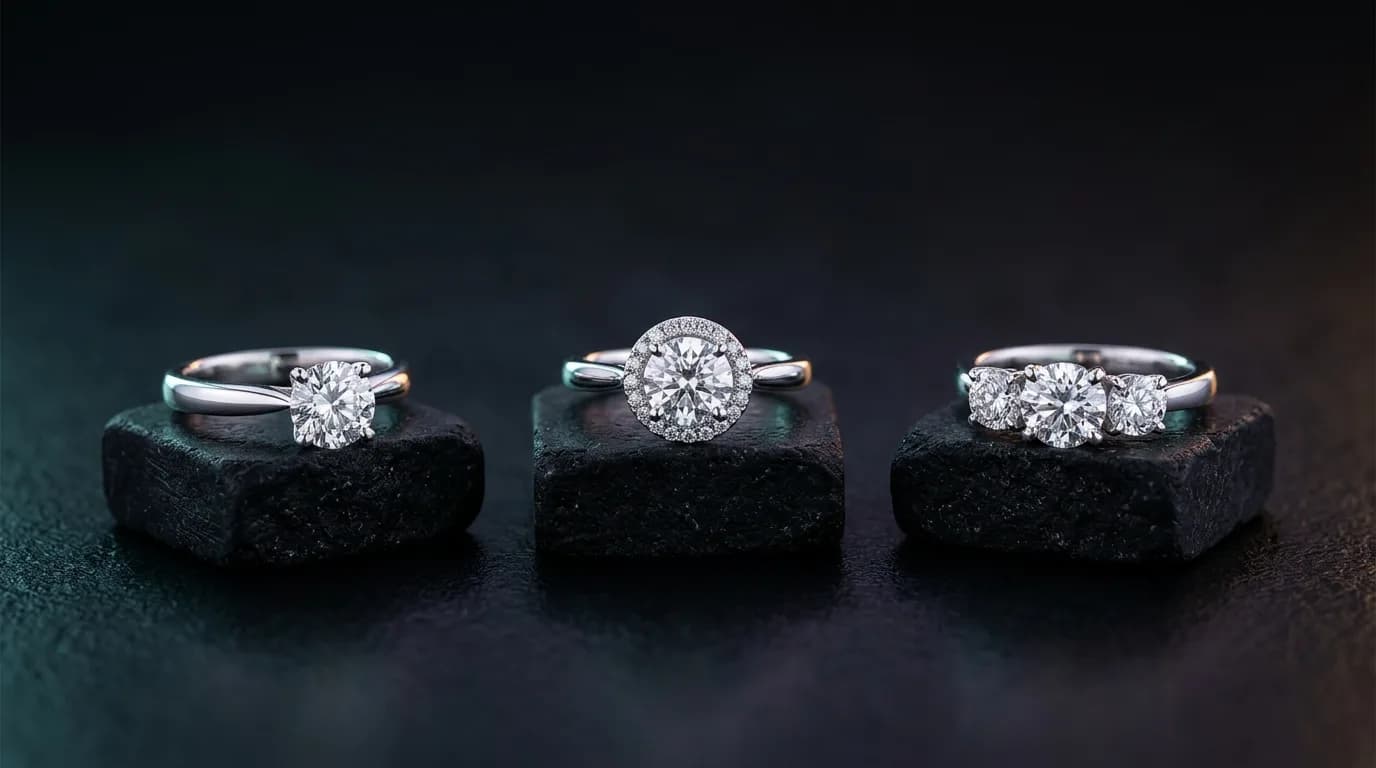
Buying an engagement ring for the first time can feel like walking into an exam you didn't study for. It isn't. There are really only four decisions, and taken in the right order they're easy. Here's the whole thing, minus the pressure and the upselling.
1. Set a number first
Before you look at a single ring, decide what you're comfortable spending. Ignore the old "three months' salary" rule — it was a diamond ad, not financial advice. A ring you bought without stress beats a ring with a payment plan. Working backward from a real number keeps the whole process sane.
Here's the part the jewelry counter won't volunteer: the number itself matters far less than it used to, because the stone you choose moves the price by a factor of ten before you've changed anything visible. Which brings us to the table below — the same look, at wildly different totals, depending on what's in the setting.
The budget cheat sheet
Roughly what each budget buys on a hand. Prices are typical US retail; the moissanite column is what we actually sell.
| Budget | Mined diamond | D-color moissanite |
|---|---|---|
| $150 | No center stone at this price | 1–2ct solitaire in S925 silver, GRA certificate in the box |
| $500 | A very small stone or lab-grown chip | The biggest, brightest pieces we make — 6ct certified cuts included |
| $1,500 | ~0.5ct in a simple setting | A full set: ring, matching band, tennis bracelet, money left over |
| $5,000+ | ~1ct with a respectable certificate | You genuinely can't spend this much on one moissanite ring. That's the point. |
2. Choose the stone
This is where the budget does the most work. A mined diamond spends most of your money on scarcity. A moissanite gives you the same look — often more sparkle — for a fraction, so the same budget buys a bigger, brighter stone. If owning a diamond specifically matters to you, that's valid; if the look and value matter most, moissanite wins on the math.
The specifics, since you'll want them: moissanite refracts light at 2.65 to a diamond's 2.42 and throws more than twice the colored fire (0.104 dispersion vs 0.044). At 9.25 on the Mohs scale it's harder than sapphire — a stone you can wear doing dishes, lifting, typing, living. Every stone we set is D-color, the top colorless grade, and ships with its GRA certificate so you have it in writing. If you want the full breakdown, our moissanite vs diamond guide covers it honestly, trade-offs included.
3. Pick a setting
The setting is the style: a solitaire (one stone, timeless), a halo (a ring of small stones around the center for extra sparkle and size), or a three-stone (past, present, future). Beyond looks, settings affect durability — bezel and halo settings protect the stone, which matters for an everyday ring. Choose the look she'd actually wear, not the trendiest.
A quick read on each: solitaires never date and make the center stone the whole story — if she wears simple, classic jewelry, stop here. Halos read bigger than their carat count and suit maximalists. Three-stones carry meaning and width. Bezels (metal wrapped fully around the stone) are the pick for nurses, climbers, gym regulars — anyone whose hands work for a living. And pear or teardrop cuts visually lengthen the finger, which is why they keep showing up on hands you scroll past.
Metal, while you're here: all of ours is solid S925 sterling silver — never plated brass — with 18K gold or rose-gold plating on request. White metal reads "platinum" on the hand; gold tones read warmer and vintage.
4. Nail the size
Get the finger measured or borrow a ring she wears and match it to a size chart. When between sizes, size up — loose is wearable, tight isn't. And most rings can be resized later, so a small miss is fixable, not fatal.
If it's a surprise: borrow a ring she wears on that finger for an afternoon, trace the inside circle on paper, and match it with our ring size guide — it takes 30 seconds and a piece of string. Most women's rings sold in the US land between size 6 and 7, so if you're truly guessing blind, 6.5 misses by the least. But borrow the ring. It's better.
Five mistakes to skip
One: buying for the photo instead of the person. A ring that photographs loud but doesn't match how she dresses gets resized into a different ring eventually. Two: ignoring her hands' actual life — a high-set solitaire on a rock climber is a stone waiting to catch. Three: guessing the size when a borrowed ring was sitting right there. Four: paying for pedigree — two stones can look identical on a hand while one costs ten times more, and the difference is a certificate's brand name, not the sparkle. Five: ordering last-minute. Order well ahead of the date — proposals have deadlines.
That's genuinely it
Budget, stone, setting, size. Everything else — metal color, cut shape, engraving — is personal flavor on top. Get those four right and you've bought a ring she'll love, without overpaying for the privilege.
And if you want the shortcut version: pick a number that doesn't scare you, put a D-color moissanite in a setting that matches her actual style, size up when unsure, and order two weeks before you need it. Done.
QuestionsPreguntas
How do I buy an engagement ring on a budget?
Set your number first, then choose moissanite over a mined diamond — you get the same look for a fraction, so your budget buys a bigger, brighter stone. Keep the setting simple and the metal sterling silver to hold the total down.
What's the most important thing when buying an engagement ring?
Getting the four basics right in order: budget, stone, setting, size. Nail those and everything else is personal preference. Don't let anyone upsell you past your number.
Can an engagement ring be resized later?
Usually yes — most rings can be adjusted, so if the size is slightly off it's an easy fix. When in doubt, size up.
What ring size should I guess for a surprise proposal?
Don't guess if you can help it — borrow a ring she wears on that finger and match it to a size chart. If you're truly blind-guessing, US 6.5 misses by the least, and sizing up beats sizing down.
How far ahead should I order an engagement ring?
Two to three weeks before the day. A buffer beats a nervous refresh of the tracking page.
Keep readingSigue leyendo
- Moissanite vs Diamond: An Honest ComparisonMoissanita vs. diamante: una comparación honesta →
- Is Moissanite Worth It? An Honest Take¿Vale la pena la moissanita? Una opinión honesta →
- How Much Does Moissanite Cost? A Clear Price Breakdown¿Cuánto cuesta la moissanita? El precio explicado →
- What Is Moissanite? The Complete Plain-English Guide¿Qué es la moissanita? La guía completa y sencilla →